Friday, July 1, 2022

An Introvert's Guide to Friends and Enemies


Recently, at the suggestion of a distant relative I met on Facebook, I started reading a book about friends and enemies. Some of the things it stated about friends and enemies got me thinking about how I would describe each. Or if I even have any of each.

While I’m not finished the book, I did try, based on what I’ve read so far, to compile a list of how I would categorize people, to see what friends and enemies I may have.

Acquaintances: These are people I have met that I have not had much contact with. I may see or interact with these people on occasions such as both of us having a mutual friend and being at the same gathering. These are not people I know well enough to know if we have anything in common beyond living on the same planet. Acquaintances can also be people I have met and know enough about to know I don’t care to be friends with them, but I have no particular enmity for them.

Casual acquaintances: Those I know, either well or not, but socialize with because they’re friends or relatives of family members. These are people I can be friendly toward, but would never have chosen as friends if I were picking friends. This is generally because we don’t have enough in common. They are not people who would invite me to a gathering were it not for my husband or other family member that I’m related to. Some might call these people “friends of friends.”

Neighbors: These are people who live in my neighborhood or once did, with whom I have only a passing acquaintance, but whom I would willingly help out for a project, and would hope for the same from them.

Colleagues: Those with whom I work, but have little to no social contact with outside the office. We are friendly because we work together – and sometimes they maintain friendly contact after we’re no longer working together because they wish a reference for a new job or some other work help. These are not people I would socialize with outside the work environment either because of a huge age gap or because we have nothing in common beyond our jobs.  If we went out together, it would only be in a work-related situation – e.g. a baby shower/wedding shower given for someone at work, or  a mandatory “team building” outside work. I have generally tried to avoid team-building situations, as I find rather than team building, they give people ammunition with which to make fun of others, or at least those less competent than they.

Professional friends: These are like colleagues, but I never had a job with them. An example would be someone who was my teacher in a class or individually, or someone for whom I held the role of teacher. I like them, but I don’t know that we have a whole lot in common beyond the subject that was taught. Sometimes they are people that I’ve performed with musically (not professionally) or we have fenced together, but I’m not part of their friend cohort. Professional is probably the wrong word, but it’ll do for lack of another.

Distant friends: There are a couple of kinds of these. The first is people who were once good friends, but for whatever reason have grown distant interest-wise. These may be people who, because of their growth as humans or mine, no longer share values or interests, but we still have some things in common. I do enjoy seeing these people from time to time, but would not go out of my way to see them.

The second kind of distant friend is one who is still a good friend, but we live too far from each other to visit one another. Another possibility for us not getting together is that their spouse doesn’t like me, or I’m not interested in spending time in company that includes some family members they may live with.

Situational friends: These are people I consider friends or good friends, but who don’t get along with each other, so I can never see them together. They either don’t like one another, or don’t have shared interests. They may even have been friends with each other at one time, but for whatever reason, that friendship fell by the wayside. They may get upset if I choose to be with the other one when they want to see me. No one will make me choose A or B. That’s my decision. If they choose not to include me in their list of friends, that’s on them. Usually, I will get together with whichever friend invited me first. I try to accommodate as best I can and respect their dislike for one another.

Childhood friends: These are people I’ve known since childhood. We’ve never had a falling out, but we’re not in frequent contact. We have each other’s addresses and send birthday and Christmas cards. We have a good time when we do see each other, but usually things get in the way of us getting together.

Friends: These are people I see fairly often, and enjoy being with. We usually have a good time, but I don’t feel I could depend on them in desperate situations. These are not the people you could call in the middle of the night in an emergency. They’re daytime friends. They’re social friends. And we don’t know enough about each other to be able to depend on each other.

Good friends: These are people who know a lot about me, and I know a lot about them. We may have stopped seeing each other at different points in our lives (like when they got married and had kids and I didn’t), but we maintained some sort of contact, and have managed to stay in touch and visit often. We are people that hit it off, have the same values and sense of humor, can speak frankly to one another, and could call one another in the middle of the night in an emergency. Of this type of friend, I have enough to count on one hand and still have a finger or two left over.

Other friends: There are also people I like who don’t like me. I’m not sure how to classify those people. I try not to bother them once I know that they don’t like me. No one intentionally walks into a wall, do they?

There are also those I don’t care for who, for whatever reason, seem to like me (I seem to attract a certain segment of the population with whom I share few, if any, interests.) I call these people annoyances. I’m polite to them, as I am with strangers, but apparently, they mistake this for friendship. I suppose I consider them acquaintances.

It seems to me there are a few other categories, but I can’t think what to call them, and this probably already sounds like splitting hairs.

Enemies: As for enemies, this is more difficult. I don’t actively hate anyone. It takes too much energy. There are people I have hated at the time they did something, either to me or to someone I cared about, or took a moral stand I couldn’t tolerate. These people make me angry when I hear about things they do, or when they try to pull a fast one on me, but in general, I don’t think about them.

Generally “enemies” are people I wouldn’t trust for any reason, either because of who they are as individuals, or because they have, at some point, betrayed me. Most people who have hurt me or betrayed me, I have given a second chance. I believe in forgiveness. I believe people can make mistakes. But if it happens a second time, that’s it.

An example of this is a “boyfriend” I had in my 20s. Our entire relationship was based on a lie. Yet, even after our “relationship” had ended, he would, from time to time, contact me to try to rekindle our fake friendship. He wasn’t trying to be friendly. His whole intent was about control. Early on, I wanted to believe he actually cared, but when I really looked at things I realized all he ever did was gaslight me, so I cut him off entirely. I actually laughed when I got a friend request from him on Linked-in. I can only imagine what he might have tried to do to me on that site.

Another example is a former colleague who, when given the chance, stabbed me in the back at work, despite the fact that whenever she came to me for help, I gave it. It got to the point where I had to make sure she or her friends weren’t around if I said anything. When I left that work site, she actually had the temerity to find me on Facebook and do a friend request. Repeatedly, until I blocked her.

Compared to those two, who are the only “enemies” that come to mind, the schoolyard bullies from elementary school were a walk in the park.

There are lots of people who are annoying, but I don’t consider them enemies. They’ve never specifically done anything beyond not going away after it was obvious their presence wasn’t wanted.

Talk about enemies makes me feel like I’m a snob. I don’t think I am. I don’t think I’m anyone special. I will at least try to be friendly with most people. Usually they are the ones who decide we will not be friends, and I can accept that. I won’t go where I’m not wanted.

I don’t see myself as having many friends or enemies. Perhaps I’m naïve in that. Perhaps it’s just the fact that I’m an introvert, and no matter how good a friend you might be, I need my down time. I spend the majority of my free time by myself, and it doesn’t bother me. I'm the one who will agree to plans someone is making and immediately regret it. But if I give my word, that's it. I honor it.

I travel alone often because I want to go somewhere that doesn’t interest my husband. He’s okay with that. It doesn’t bother me at all because I can go where I want when I want, and I don’t have to compromise with a traveling companion. As long as my flights and excursions don’t get cancelled, and I have a good book, pen and paper, I’m a happy camper.

Wednesday, June 1, 2022

Fun with Words


Words have always fascinated me. I love playing with them. I’ve coined a few (yumptious, for one), and it surprises me when, several years later, I hear my word being used by others, as if it’s always been there. If I mention having made it up, I’m met with doubt. Such is life.

Because of my love of playing with words, I notice all sorts of words used by others.

Writers are supposed to be word people, delighting in crafting stories, and evoking emotions and visual images through the use of words.

Something I’ve noticed about both new writers and authors who write book series is a tendency to have a favorite word – often an ostentatious one – and use it to excess. I’m sure other writers do the same, but these are the ones I’ve noticed doing it the most.

When I see a new writer doing this, especially when the most notable thing about the novel is the over use of a single ostentatious word, I think how unjust it is that they have been accepted by a publisher and I have not. (To be honest, my muttered comment is, “Who did they sleep with to get that publishing contract?”)  But I don’t just blame the author, I also blame the editor. The editor’s job is to pick up on things that interrupt the flow of the work.

When I see a well-known writer using such words, I think, you should know better!

I suspect that when an author reaches some amount of celebrity or success, editors may become loathe to make recommendations, not wanting to interfere with an author’s style. Perhaps that isn’t the case, since it is their job to make those recommendations. Possibly an editor who has been working with the same author over several novels has simply stopped noticing the repetitiousness of the writing style.

I had a couple of my own bad habits pointed out to me by various means.

In the beginning of my career as an OT, before laptops were common, one hospital I worked for insisted on us using Dictaphones to record our evaluation reports. This was supposed to be a work saving device. Since I needed to write down everything I wanted in my report so that I didn’t forget anything essential, it was an extra step for me.

Once I had everything organized, I’d record what I wanted on the Dictaphone so the secretary could then type it up. I always proof read what the secretary had typed for accuracy before signing.

This had two benefits for me. The first was discovering that the secretary constantly “corrected” one particular verb in my work. When I told her I knew what I originally wrote was correct, and what she had put was wrong, since I also had a degree in English, and the incorrect version was a personal peeve of mine, she agreed with me, but said her boss insisted that the incorrect word was the right one. I told her (very respectfully) I would not sign the paper unless she fixed it, and on all of my papers, I wanted it the way I had written it.

Seeing, “Signed but not read” horrified me. These were legal documents and inaccuracies, if legal action was ever taken, could be costly.

The second benefit of being required to dictate my evaluations is that I discovered some of my quirks. The most glaring was my tendency to overuse the word, however. Most of the time, it served no purpose, so I strove to eliminate it from my writing. In the meantime, I asked the secretary to ignore it whenever I used it on the Dictaphone. She and I had a chuckle over it, and she helped me improve my writing in this way.

Another bad habit I had was writing very long, complicated sentences. A teacher in one of my psychology courses had us write a paper every two weeks. My first paper received a 99% with a note that my sentences, while grammatically correct, were long and hard to follow, which was the only reason it didn’t receive a 100%. The second paper was entirely short, simple sentences. He gave me a 100% with a note, “I see what you did there.” If smiley faces had been a thing then, he would have put one on the paper. That new awareness of a style problem helped me immensely.

Having been made aware what errors I was making in school as well as in my professional life made me more aware of what errors professional writers make.

One author of a trilogy of vampire novels took a shine to the word, “rictus” to describe the vampire’s smile. When I first saw it, I thought, Cool word! I’ve never seen that one before. Unfortunately, nearly every time said vampire was mentioned, so, too was the rictus smile.

I’m practically a hoarder when it comes to books. For me to get rid of a book is something major. But by the time I finished the vampire trilogy, I was ready to unload those books, rictus smile and all.

I never saw anything else by that author, so it’s possible the overuse of the word rictus did him in.

And then we come to author of the most overused word or description in a series turned into a TV show: Diana Gabaldon of Outlander fame.

After I watched the first season of Outlander, I decided to read the novel to see how closely the series followed the book. The book was rather hefty, and reading an 850-page novel in paperback without breaking the binding was a challenge, but I committed to the whole series. The first novel turned out to be the smallest one.

Diana Gabaldon’s scope and description made it easy for Outlander to be turned into a TV series. Little, if anything, was left out, although a couple of things were altered for no apparent reason.

While I was enchanted with the first novel, I was less than thrilled with Ms. Gabaldon’s writing style and the lack of sufficient editing.

While the first novel in any series requires a great deal of detail for setup, subsequent ones don’t. They can be shorter, but each one of Gabaldon’s is longer than the one before it.

The reason appears to be that there was too much information introduced in each one. Yes, they take place in very real, historical periods (The Battle of Culloden and subsequent highland clearances, as well as the American Revolution), but there were scenes of violence, and unnecessary characters introduced that did nothing to further the plot, even in later novels. Many of these instances simply cluttered the stage with characters.

And then there’s the hair. Jamie Fraser, the main character is a redhead. This is extensively documented in the first novel. It might be useful to mention it once in the other novels as a reminder, or for anyone who might mistakenly start the series with a different one of the books. It’s quite distracting, not to mention annoying to hear about the 50 shades of ginger on his head, beard, arms, torso, or elsewhere each time Jamie enters a scene.

Perhaps I exaggerate slightly. But, taking out all but one mention of Jamie’s hair being red would cut each book by about 50 pages.

When I submitted a novel to an editor, I was told that 500 pages was too long for a first novel, and I should shorten it – and none of those pages obsessed over hair. How did she justify 850 pages followed by novels of well over 1,000 pages each thereafter?

Not until the seventh novel did Ms. Gabaldon calm down the mention of Jamie’s hair to perhaps 10 pages of description. But in that novel she discovered the word dubiously.

There’s really nothing wrong with the word dubiously except that it’s a showy word. It means doubtfully. Why not simply use doubtfully? (She never does)

Dubiously seems ostentatious, as if the author needed to show off a new thesaurus. Dubiously is doubtfully rolled in glitter. Being more noticeable, its overuse eventually felt like being bashed about the head with it.

This word makes an appearance on nearly every one of the 1149 pages of novel seven. The author even tried to coin a new word with dubious as its root (I think it was dubiosity).

I was tempted, when reading this one, to dress up like Inigo Montoya from The Princess Bride and say, “I do not think that word means what you think it means.”

It was a disappointment to see such glaring overuse of a word that has a simpler synonym by such an acclaimed author. Perhaps if she’d used doubtfully instead, she might have noticed the overuse.

My disappointment has inspired me to suggest a few glittery words that it would be best to avoid, or at least limit to once in a written work. All of them appeared in Gabaldon’s seventh Outlander novel. Here are my selections:

Utilize. This means use. Often used by people trying to sound like experts. It doesn’t make them sound that way at all. It makes them sound like 12-year-olds with a new vocabulary word. If you mean use, say use.

Lessen. This means decrease. It’s been around for 600 years, so maybe it should be laid to rest. Decrease sounds less awkward.

Orb. This means “a spherical body especially a spherical celestial body; A sphere surmounted by a cross symbolizing kingly power and justice.” Using it to mean something circular is an archaic meaning of the word, yet this is the way it is often meant. Or as a replacement for eyeball.

Bemused. This means “dazed, marked by confusion or bewilderment.” It can mean “wry amusement, especially from something that is surprising or perplexing.” Unfortunately, people often incorrectly use it interchangeably with amused. If you don’t understand the definition, don’t use the word.

A final word I’ve recently seen misused is partake when the person means participate.

Participate means to take part in something.

Partake “implies accepting… a share, especially of food and drink.”

Words can be fun to play with, but make sure you only use the ones you understand. And if they have glitter on them, use them with caution.


Sunday, May 1, 2022

Ukraine


Blue Scream of Jeff (check out his blogs) and I were married in 1994. Half of our two-week honeymoon was spent in my ancestral homeland of Ireland.

St Michael's Cathedral, Kyiv
To celebrate our 10th anniversary, we decided to go to Jeff’s ancestral homeland, which he thought was Russia. We only later discovered it was actually Belarus.

While we knew the history of Russia, essentially all we really knew about its geography was that it was vast. What to see, where to go and how to get there were our main questions.

A travel agent – remember those? – recommended a cruise: “The Footsteps of the Tsars.” It sounded amazing. Unfortunately, it was 28 days long, and neither of us had that much vacation time, or the money to pay for it.

But as we looked through the brochures, one river cruise checked the boxes: Ukraine. A river cruise down the Dnieper, starting in Kyiv, and making stops at towns and villages along the river to Odessa, then across the black sea to the Crimea and Yalta. It allowed us to visit places of incredible beauty, learn the culture and a little of the language, and visit places of history while seeing how everyday people lived.

Most of the people in Ukraine spoke Russian as well as Ukrainian. I knew a little bit of Russian, I could say please, thank you, yes, no, count to 10 and ask, “What is that?” I could also say my name is Ekaterina Eduardovna Prizhnovskaya, the female version of Jeff’s surname before his great grandfather changed it to Price. (And yes, I can also write that in cursive Cyrillic; thanks for asking.)

Children's traditional folk dance recital

At the time, Viking Cruises was a fledgling business that catered more to Europeans. We were one of only six American couples on the cruise. Our guide tended to point out things she thought would be of interest to “You British people,” such as the site about which Alfred, Lord Tennyson wrote The Charge of the Light Brigade, which occurred during the Crimean War. Imagine a busload of British, Australian and American tourists reciting that poem from memory.

There were quite a few cultural shocks in Ukraine at the time. While in Kyiv, we discovered there was only one ATM in the entire city. When we spoiled Americans asked why, our tour guide gave us a vague smile while looking at us as if we were a group of slow-witted children and said, “We have only had independence for 13 years.”

Thinking of our own country, we had no ATMs 13 years after gaining our independence. Then again, in 1794, we didn’t even have light bulbs.

Another shock at the time was being told before touring places in the countryside that there were only “primitive toilets”, which consisted of a hole in the floor surrounded by a lovely ceramic ring – bring your own toilet paper. Surely, this couldn’t be true of a European country in the 21st century? While it has probably changed since then, it was certainly true then.

Performance in Novaya Kakhovka
This year, as the Russians invaded, and the news reported that all men between the ages of 18 and 60 were required to fight in the resistance, I was reminded of a question someone asked back on our tour in 2004 about the average life expectancy in Ukraine. While we thought it might be somewhat lower than in Western Europe, we were not prepared for the answer the guide gave us. We were told it was 62 for women and 59 for men.

Surely not!

Why?

Again, the sad smile as she spoke the single word: Chernobyl.

The people who lived near Chernobyl weren’t evacuated soon enough, and later, they were allowed to return too soon. The result was that many people developed cancer.

And of course, having independence for only 13 years, they had no cancer hospitals, and could not afford to go to other countries for treatment.

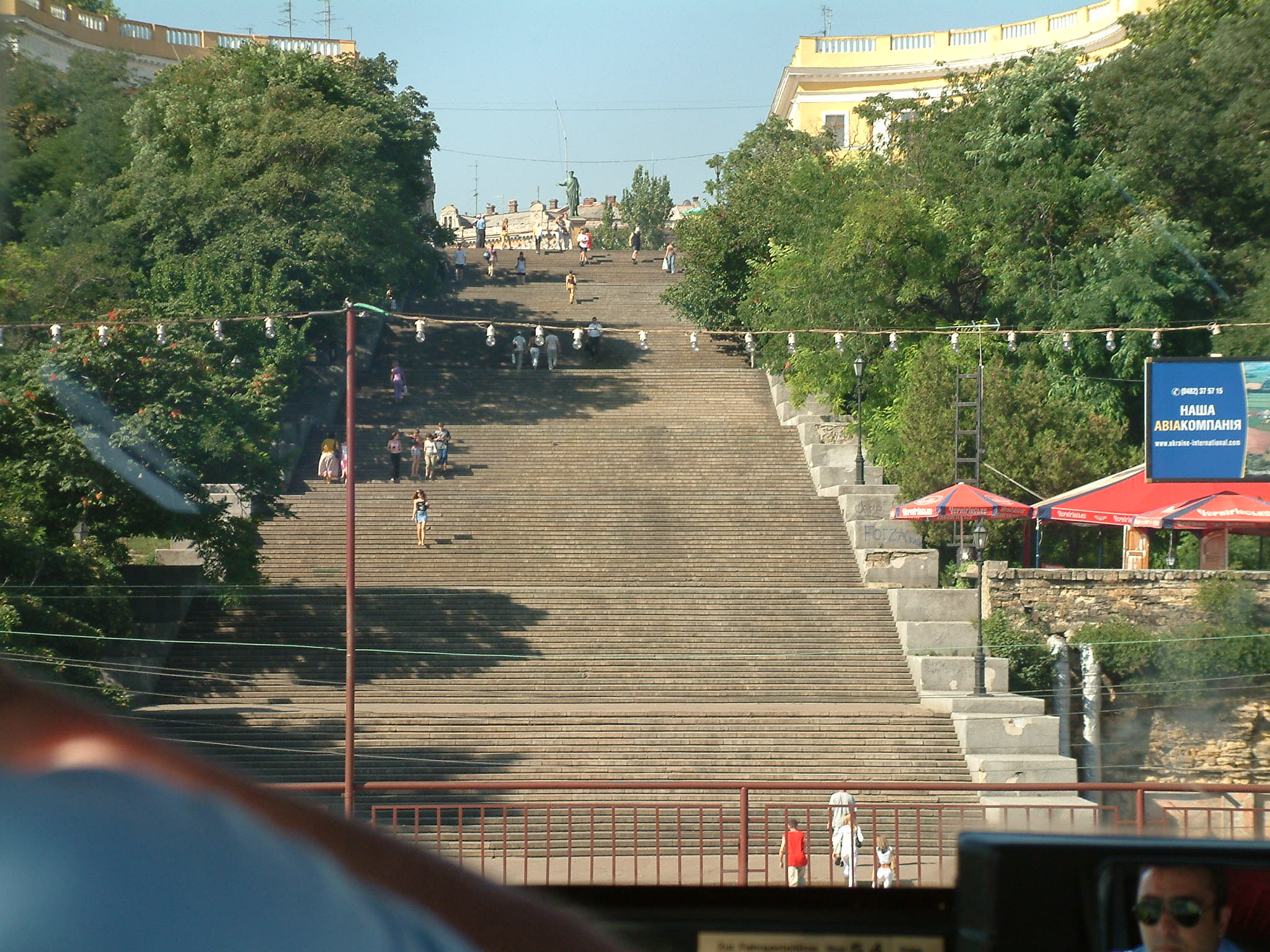
The Odessa Steps

Indeed, age 35 appeared to be a turning point. We were told many of the Babushkas we saw in the parks were not as old as we thought. While young people were stunningly beautiful, once one hit 35, their hard life caught up with them and a look of old age began to creep in with alarming speed.

Ukrainians did not sit around feeling sorry for themselves. They are dynamic, proud and generally happy people, kind, and fierce in their loyalty. They were happy to explain their traditions and have us foreigners experience their culture.
We saw the skill of the horsemen when we visited Zaporizhia, watched performances of Hopak dancing, and tasted the Ukrainian version of Moonshine, homemade vodka, that packs a burning punch far stronger than anything available in a local liquor store.

The onion-domed churches were works of art inside and out. The Odessa Steps were far more impressive in person than on film, and everywhere were beautiful parks.

Livadia Palace, Yalta
There were stray dogs around, but they were cared for by the people who lived in the towns. There was almost no litter because every morning the Babushkas went around picking it up. They saw it as their purpose.

In Yalta, the Livadia Palace is worth a visit not only because it was a residence for the Romanovs, but also because it was the site of the Yalta Conference, with phones and strategy rooms that were used by Churchill and FDR still in place.

Ukraine was a country of contrasts and extreme beauty, and I’m glad I had the opportunity to see it. To see places I visited reduced to rubble now is heart-wrenching.

Lives have been lost because a despot wishing to drag Ukraine back to the bad old days of the Soviet Union has gone power mad. It is heartening to see the resolve of the Ukrainians against the invaders.

No one knows how this war will turn out, but I’m reminded of a line from a Cold War era song by Sting: I hope the Russians love their children, too.